





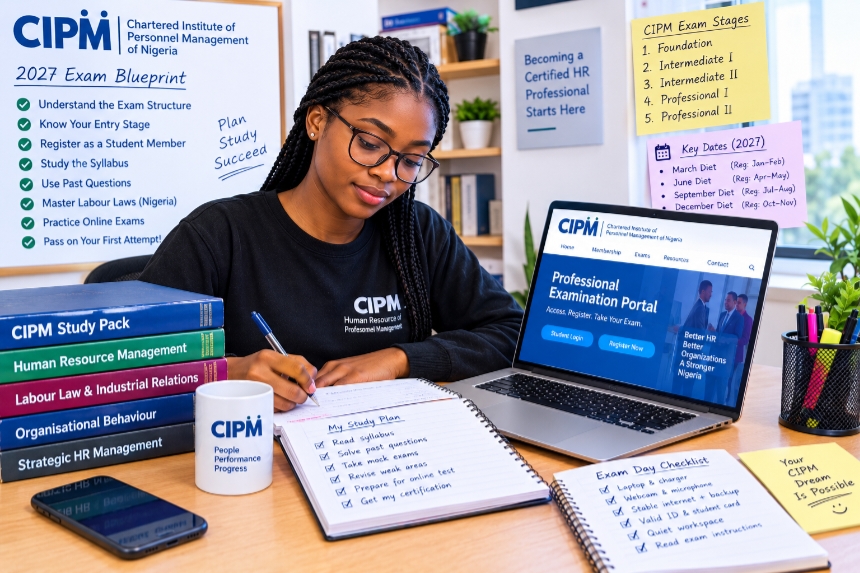
Preparing for the Chartered Institute of Personnel Management of Nigeria (CIPM) examinations requires more than memorising definitions. The examination route is designed progressively, taking candidates from foundational management and business concepts through human resource management, organisational performance, employment relations and Nigerian labour law.
- 2027 CIPM Examination Structure: Know Your Stage
- How Your Academic Qualification Determines Your Entry Stage
- The Four CIPM Examination Diets
- CIPM Examination Fees: What You Need to Budget For
- The Master 4-Step Blueprint for Preparing for CIPM Exams
- Step 2: Move Beyond Memorisation
- Step 3: Use Past Questions as Diagnostic Tools
- Step 4: Build a Realistic Study Schedule
- How Many Papers Should You Take?
- Master Nigerian Workplace Context
- Build Better Examination Answers
- Prepare for CIPM’s Online Examination
- What Not to Do During the Online Examination
- Use a Three-Layer Revision System
- Keep a CIPM Mistake Notebook
- 30-Day CIPM Revision Blueprint
- Frequently Asked Questions
- Final 2027 CIPM Examination Checklist
- Final Thoughts
For candidates planning to pursue the CIPM qualification in 2027, understanding your entry stage, examination subjects, registration requirements and study strategy can make preparation much more organised.
This guide provides a practical blueprint for preparing for the CIPM examinations, including the five examination stages, exemption routes, examination diets, fees, online examination preparation and study techniques.
Important: CIPM fees, examination dates, registration deadlines, examination procedures and technical requirements can change. Always confirm the information displayed on the official CIPM portal before making payment or preparing for a particular examination diet.
2027 CIPM Examination Structure: Know Your Stage
CIPM currently conducts its professional examinations in five stages:



- Foundation
- Intermediate I
- Intermediate II
- Professional Examination I
- Professional Examination II
The subjects become progressively more specialised as candidates move toward the Professional stages.
Foundation
The current Foundation subjects include:
Related Articles



- Principles of Management and Business Development
- Introduction to Financial and Management Accounting
- Fundamentals of Psychology, Sociology and Politics
- Introduction to Human Resource Management
- Elements of Nigeria’s Business Law and Legal System
- Digital and Management Information System
Intermediate I
Subjects include:
- Business Administration and Practices
- Fundamentals of Economics
- Finance for Human Resource Managers
- Business Statistics and Social Research Methods
- Communication Process, Management and Development
Intermediate II
Subjects include:
- Learning and Development
- Public Administration and Leadership
- Workforce Planning and Strategies
- Comparative HR Management
Professional Examination I
Subjects include:
- HR Metrics and Analytics
- Organisational Behaviour and Performance
- Insurance, Pensions and Risk Management
- Advanced Human Resource Management I
- Presentation Skills
Professional Examination II
The final stage currently includes:
- Nigerian Labour Law
- Employment Relations
- Advanced Human Resource Management II
- Labour Market Analysis
These subjects reflect CIPM’s current published examination structure.
How Your Academic Qualification Determines Your Entry Stage
One of the first things to establish is where you enter the examination route.
You do not necessarily have to begin at Foundation if your academic qualifications make you eligible for an exemption or a higher entry stage.
CIPM’s current published exemption provisions include the following broad categories:
| Entry Stage | Examples of qualifications listed by CIPM |
|---|---|
| Foundation | Undergraduates from recognised tertiary institutions; degrees/HNDs in pure and applied sciences and other science-related disciplines |
| Intermediate I | Degrees/HNDs in management and social sciences excluding HR/IRPM, humanities, arts and law; certain science-related Master’s degrees |
| Intermediate II | Degrees/HNDs in Human Resources Management, Industrial Relations and Personnel Management; certain Master’s/MBA qualifications in management and social sciences; specified professional qualifications |
| Professional I | M.Sc./MBA/Ph.D. in Human Resources Management, Industrial Relations and Personnel Management |
| Professional II | Final stage of the CIPM professional examination |
Your exact entry point should be determined using the qualification and exemption rules applicable when you register.
Don’t Assume Your Degree Guarantees a Particular Exemption
For example, having a degree in Business Administration does not mean that every candidate will necessarily enter at exactly the same point under every future examination arrangement.
CIPM evaluates qualifications according to its published entry and exemption provisions.
If you are uncertain, check your qualification against the current CIPM requirements before paying examination or exemption fees.
The Four CIPM Examination Diets
CIPM currently states that its online examinations are held four times a year, and candidates must have been admitted as student members at least one month before the examination date.
The four examination periods are generally:
- March
- June
- September
- December
However, do not treat these months as a substitute for the official 2027 timetable. The actual examination dates, registration windows and deadlines should be confirmed from CIPM’s published timetable for each diet.
A Practical 2027 Planning Approach
Instead of waiting for an examination registration deadline, build your preparation around the likely diet you intend to sit.
Before your chosen diet:
- Confirm student membership status.
- Confirm your examination stage.
- Check approved exemptions.
- Review the applicable subjects.
- Obtain current study materials.
- Download relevant past questions.
- Create a weekly study schedule.
- Complete your examination registration early.
- Test your online examination setup.
CIPM’s 2026 examination timetables demonstrate the four-diet structure and show that individual subjects are scheduled across specific examination days and times.
CIPM Examination Fees: What You Need to Budget For
CIPM fees can change, so candidates should not treat figures from an old blog post as permanent 2027 prices.
The Institute’s current examination FAQ lists examination fees according to the number of subjects selected, rather than simply charging one identical amount for every candidate at a particular stage.
For example, the currently published fee table lists:
| Examination Stage | 1 Paper | 2 Papers | 3 Papers | 4 Papers | 5 Papers | 6 Papers |
|---|---|---|---|---|---|---|
| Foundation | ₦12,475 | ₦24,720 | ₦35,205 | ₦44,445 | ₦52,440 | ₦55,440 |
| Intermediate I | ₦14,870 | ₦28,825 | ₦43,235 | ₦54,675 | ₦57,190 | — |
| Intermediate II | ₦18,915 | ₦34,775 | ₦50,460 | ₦58,200 | — | — |
| Professional I | ₦20,495 | ₦35,870 | ₦50,730 | ₦59,440 | ₦64,050 | — |
| Professional II | ₦23,645 | ₦45,430 | ₦63,180 | ₦70,050 | — | — |
CIPM also lists separate exemption fees for candidates entering above Foundation. The exemption fee is paid once and is charged in lieu of the stage or stages from which the candidate is exempted.
Important
These figures are current published benchmarks, not guaranteed 2027 prices.
Before paying:
- Log into the official CIPM portal.
- Select the correct examination stage.
- Select your intended subjects.
- Review the invoice generated by the system.
- Confirm any applicable exemption fee.
- Save your payment evidence.
The Master 4-Step Blueprint for Preparing for CIPM Exams
Step 1: Study the CIPM Syllabus, Not Random HR Notes
One of the easiest ways to waste study time is to collect dozens of HR materials without checking whether they actually correspond to the current CIPM syllabus.
Start with the official syllabus and identify:
- Your examination stage.
- Your subjects.
- Major topics.
- Learning objectives.
- Areas requiring calculations.
- Areas requiring explanations and application.
- Relevant Nigerian laws and workplace concepts.
CIPM also publishes past examination questions, which can help you understand the type of material candidates have been tested on previously.
Create a Syllabus Audit
For every subject, divide your topics into three categories:
Green — Strong
You understand the topic and can answer questions without relying heavily on notes.
Yellow — Developing
You understand the basics but need more practice.
Red — Weak
You struggle to explain, apply or remember the material.
Spend most of your revision time moving red topics toward yellow and yellow topics toward green.
Step 2: Move Beyond Memorisation
CIPM preparation should not be based entirely on memorising definitions.
For each concept, ask yourself:
What does this mean?
Then:
Why does it matter to an organisation?
Then:
How would an HR professional apply it?
For example, when studying performance management, do not stop at memorising its definition.
Consider:
- Why organisations measure performance.
- How performance objectives are established.
- How managers provide feedback.
- How poor performance is addressed.
- How performance data can influence development.
- How performance management connects with organisational goals.
This approach makes it easier to answer questions that require explanation, application or analysis.
Step 3: Use Past Questions as Diagnostic Tools
CIPM provides past examination questions through its official platform.
Use them strategically rather than simply reading the answers.
The Three-Pass Method
Pass 1: Untimed Attempt
Answer questions without looking at your notes.
This reveals what you actually remember.
Pass 2: Mark Your Weak Areas
Compare your response with the relevant study material.
Identify:
- Missing concepts.
- Incorrect definitions.
- Weak explanations.
- Poor examples.
- Calculation errors.
- Areas where you misunderstood the question.
Pass 3: Timed Attempt
Repeat similar questions under examination conditions.
The objective is to become comfortable producing a structured answer within the available time.
Step 4: Build a Realistic Study Schedule
A good study schedule should fit your actual life.
If you work full-time, do not create a timetable that assumes you can study six hours every weekday when you realistically have one or two hours available.
Example Weekly Structure
| Day | Study Activity |
|---|---|
| Monday | New topic |
| Tuesday | New topic |
| Wednesday | Review Monday/Tuesday |
| Thursday | New topic |
| Friday | Short revision session |
| Saturday | Deep study + past questions |
| Sunday | Weekly review + mock questions |
The exact schedule should depend on the number of subjects you are taking and the time remaining before the examination.
How Many Papers Should You Take?
There is no universal number of papers that guarantees success on a first attempt.
The right workload depends on:
- Number of subjects remaining.
- Your previous academic background.
- Working hours.
- Family responsibilities.
- Study time available.
- Familiarity with the subjects.
- Time remaining before the examination.
- Previous examination performance.
Instead of following a rigid rule such as “never take more than three papers,” calculate the workload you can realistically prepare for.
A Simple Workload Test
Before registering for several papers, ask:
Can I consistently dedicate enough weekly study time to every subject?
Have I completed the syllabus before the final revision period?
Can I practise past questions for every subject?
Can I revise without abandoning one subject to focus on another?
If the answer is no, consider whether a smaller subject load would make your preparation more manageable.
Master Nigerian Workplace Context
CIPM’s syllabus includes subjects directly connected to Nigeria’s business and employment environment.
This means candidates should understand the Nigerian context rather than relying exclusively on generic international HR examples.
Depending on your examination stage, your preparation may involve topics connected with:
- Nigerian labour law.
- Employment relations.
- Industrial relations.
- Organisational behaviour.
- Workforce planning.
- Human resource management.
- Business law.
- Labour-market issues.
- Performance management.
For Labour-Law Questions
Do not simply memorise legal terminology.
Learn:
- What the relevant law addresses.
- The employment issue involved.
- The rights or obligations created.
- How the rule applies in a workplace situation.
- Any important limitations or exceptions.
Always use your current CIPM study materials and the applicable current Nigerian legal framework when preparing for law-related subjects.
Build Better Examination Answers
For essay or explanatory questions, avoid writing one enormous paragraph.
A clear answer can often follow this structure:
1. Definition
Briefly explain the concept.
2. Explanation
Develop the main idea.
3. Key Points
Use numbered or clearly separated points where appropriate.
4. Workplace Example
Give a relevant example that demonstrates application.
5. Conclusion
Where appropriate, connect the answer back to the question.
This structure can make your answer easier to follow and can help ensure that you address multiple parts of a question.
Prepare for CIPM’s Online Examination
CIPM currently administers its professional examinations online.
The official examination portal provides student login access for examination-related activities.
Complete a Technical Dry Run
Before examination day, check:
- Computer or laptop functionality.
- Webcam.
- Microphone.
- Internet connection.
- Power supply.
- Browser compatibility.
- Examination login details.
- Student identification requirements.
- Examination environment.
- Any software or system-check requirement communicated by CIPM.
Do not wait until the examination morning to discover that your webcam, browser or internet connection is not working.
Have a Backup Plan
Where possible, prepare for common disruptions:
- Charge your laptop fully.
- Have a reliable alternative internet connection.
- Keep your examination credentials accessible.
- Choose a quiet environment.
- Remove materials prohibited by the current examination rules.
- Follow all instructions provided by the examination platform.
The exact technical and environmental requirements should be taken from the instructions issued for your specific examination diet.
What Not to Do During the Online Examination
Online examinations are subject to examination and anti-malpractice rules.
Do not assume that something is permitted simply because you can physically place it near your computer.
Before examination day, review the current CIPM examination guidelines concerning:
- Books and notes.
- Phones.
- Smartwatches.
- Additional screens.
- Other people in the room.
- Communication.
- Internet use.
- Identification.
- Permitted materials.
Follow the current instructions exactly.
Use a Three-Layer Revision System
A particularly practical revision system is:
Layer 1: Learn
Study the topic from the current CIPM materials.
Layer 2: Recall
Close your notes and explain the concept from memory.
Layer 3: Apply
Answer a question or create a workplace scenario involving the concept.
If you can only recognise the answer when reading your notes, you are not yet fully prepared.
Keep a CIPM Mistake Notebook
Every time you make a mistake during practice, record it.
Your mistake notebook can contain:
| Topic | My Mistake | Correct Understanding | Action |
|---|---|---|---|
| Performance Management | Confused appraisal with management | Appraisal is one component within a broader performance-management process | Revise + practise |
| Economics | Formula error | Review calculation method | Solve 10 questions |
| Labour Law | Missed an exception | Re-read relevant section | Create flashcard |
By the final weeks before the examination, this notebook becomes one of your most useful revision resources.
30-Day CIPM Revision Blueprint
If you are entering the final month before your examination, structure your preparation carefully.
Days 30–21: Complete Weak Topics
Focus on unfinished sections of the syllabus.
Do not spend the entire period rereading topics you already understand.
Days 20–14: Past Questions
Start answering past questions regularly.
Identify recurring areas of difficulty.
Days 13–7: Timed Practice
Begin completing full or partial mock examinations under timed conditions.
Days 6–3: High-Yield Revision
Review:
- Definitions.
- Frameworks.
- Formulas.
- Difficult concepts.
- Labour-law topics where applicable.
- Mistake notebook.
- Past-question errors.
Days 2–1: Reduce the Load
Avoid trying to learn an entire syllabus overnight.
Prepare your examination equipment, verify your login details and review only essential notes.
Get adequate rest.
Frequently Asked Questions
How many stages are in the CIPM examination route?
There are currently five stages:
- Foundation
- Intermediate I
- Intermediate II
- Professional Examination I
- Professional Examination II
Are CIPM examinations held four times a year?
Yes. CIPM currently states that its online examinations are conducted four times annually. Candidates should confirm the exact dates for the 2027 diets when the official timetable is published.
Do I have to start from Foundation?
Not necessarily.
CIPM provides exemption and entry-stage provisions for candidates with specified academic and professional qualifications. The applicable entry stage depends on your qualification.
Can a Business Administration graduate receive exemptions?
CIPM’s published entry provisions list degrees/HNDs in Management and Social Sciences, excluding HR/IRPM, among qualifications associated with Intermediate I entry. Your specific qualification should be checked against the current CIPM requirements before registration.
Is there an exemption fee?
Yes. CIPM’s current examination FAQ states that candidates who do not start at Foundation pay an exemption fee in lieu of the stage or stages exempted, and that the fee is payable once alongside the first examination fee.
Where can I find CIPM past questions?
CIPM publishes past questions through its official website.
When are CIPM examination results released?
CIPM’s current FAQ states that results are released within a month after the examination.
Final 2027 CIPM Examination Checklist
Before your examination registration:
- [ ] Student membership is active.
- [ ] You have confirmed your examination entry stage.
- [ ] Approved exemptions have been checked.
- [ ] You have reviewed the current syllabus.
- [ ] You know the subjects you intend to write.
- [ ] You have checked the current examination fees.
- [ ] Your examination registration is completed before the deadline.
- [ ] Study materials are available.
- [ ] Past questions have been downloaded.
- [ ] A realistic study timetable has been created.
- [ ] Weak subjects have been identified.
- [ ] Timed practice has been completed.
- [ ] Your computer has been tested.
- [ ] Your webcam and microphone work.
- [ ] Your internet and backup arrangements have been checked.
- [ ] You understand the current online examination rules.
- [ ] Your student identification and login information are ready.
Final Thoughts
Passing the CIPM examinations on your first attempt requires preparation, consistency and an accurate understanding of the examination requirements.
Start by identifying your correct entry stage. Then obtain the current syllabus, divide your subjects into manageable study blocks, practise with past questions and progressively move from memorisation to application.
Do not rely on old examination fees, outdated syllabi or another candidate’s exemption status when planning your 2027 journey. CIPM’s official portal and current examination notices should be your final reference for registration, fees, examination dates and technical requirements.
Most importantly, remember that there is no single study strategy that guarantees a first-attempt pass. Your preparation should reflect the subjects you actually need to write, the time you have available and the areas where you need the most improvement.
With a structured study plan, regular practice and careful attention to the official examination requirements, you can approach your 2027 CIPM examination with a much clearer preparation strategy.