






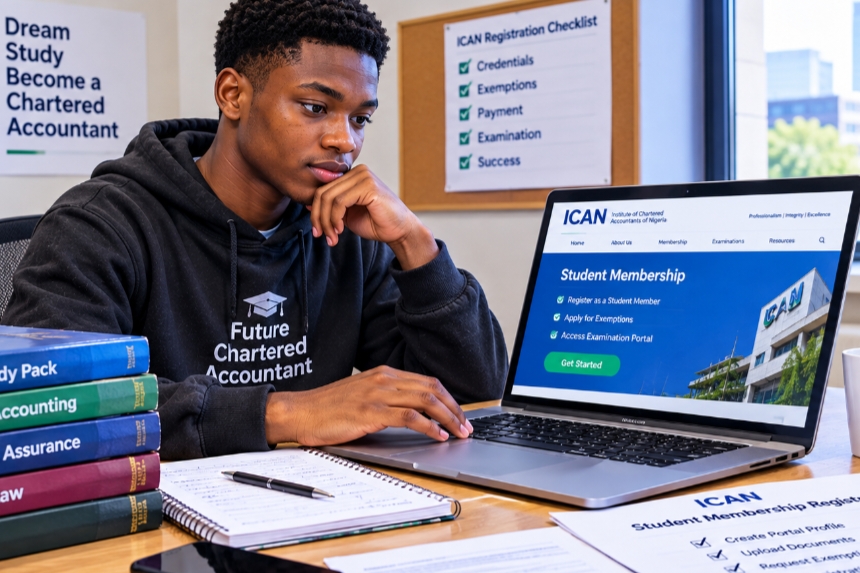
Starting your journey toward becoming a Chartered Accountant in Nigeria involves more than preparing for the ICAN examinations. Before you can register for an examination diet, you need to complete the appropriate student registration process, provide the required credentials, and, where applicable, apply for exemptions based on your academic or professional qualifications.
- 1. Who Can Register as an ICAN Professional Student?
- 2. Documents to Prepare Before Registration
- 3. Understanding ICAN Exemptions
- 4. Step-by-Step ICAN Professional Student Registration
- 5. How to Apply for Exemptions
- 6. Check Whether Your Institution Is Accredited
- 7. Submit Your Registration Application
- 8. Wait for Verification and Approval
- 9. Confirm Your Exemption Status Before Registering for Exams
- 10. Register for the Appropriate Examination Diet
- 11. Common Mistakes That Can Delay Your ICAN Registration
- 12. ICAN Registration Checklist for 2027 Applicants
- 13. How to Prepare Early for the 2027 ICAN Exams
- Final Thoughts
For candidates planning to pursue ICAN examinations in 2027, early preparation can help reduce delays caused by incomplete documentation, incorrect personal information, unverified credentials, or exemption applications that have not yet been approved.
This guide explains how ICAN Professional Student registration works, the documents you may need, how exemptions are determined, how to navigate the registration process, and the common mistakes to avoid.
Important: ICAN requirements, fees, examination dates, exemption categories, and portal procedures can change. The 2027 examination timetable and applicable charges should be confirmed on the official ICAN website and portal before you make any payment.
1. Who Can Register as an ICAN Professional Student?
ICAN’s published requirements state that applicants for Professional Student registration generally need a qualification at least equivalent to a university degree.



Accepted entry routes include:
- A university degree from a recognised institution.
- A Higher National Diploma (HND) from a Polytechnic recognised by ICAN.
- The Accounting Technicians Scheme, West Africa (ATSWA) qualification.
- Certain other recognised professional qualifications accepted by ICAN.
The exact entry route and exemption entitlement depend on your qualification and, in some cases, the institution from which you obtained it.



What About Accounting and Non-Accounting Graduates?
Both accounting and non-accounting graduates can pursue the ICAN professional qualification, provided they satisfy ICAN’s applicable entry requirements.
However, your academic background can significantly affect the subjects for which you may receive exemptions.
An accounting graduate from an ICAN-accredited institution may receive exemptions that differ from those available to a graduate of another discipline. Similarly, professional qualifications such as ACCA, CIMA and other recognised credentials may have specific exemption arrangements.
Do not assume that every accounting graduate receives the same exemptions. Check the current ICAN exemption schedule applicable to your exact qualification.
2. Documents to Prepare Before Registration
Having your documents ready before beginning the application can make the registration process easier.
Depending on your circumstances, you may be asked to provide or submit documents such as:
- WAEC, NECO, NABTEB or another accepted O’Level credential where applicable.
- B.Sc. or HND certificate.
- Statement of result where permitted by ICAN.
- Academic transcript where required.
- ATSWA certificate or relevant professional qualification.
- NYSC discharge certificate or call-up letter, where applicable.
- Birth certificate or sworn affidavit where required.
- Valid identification and other supporting documents requested by ICAN.
- Recent passport photograph.
- Marriage certificate and supporting change-of-name documentation where applicable.
- Change-of-name certificate or affidavit where applicable.
Keep Your Documents Clear and Consistent
Before uploading or submitting anything, check that:
- Your name is consistent across your major documents.
- Your date of birth is accurate.
- Your institution and course details are correct.
- Your certificates and statements of result are legible.
- Your passport photograph meets the current portal requirements.
- Any required transcript is sent through the channel specified by ICAN.
Do not rely on an old file-size limit from a previous registration cycle. ICAN’s technical requirements can change, so follow the specifications displayed on the current portal.
3. Understanding ICAN Exemptions
One of the most important parts of the registration process is determining whether your previous education or professional qualification gives you exemptions.
ICAN’s professional examination is structured into three levels:
- Foundation
- Skills
- Professional
The current syllabus contains multiple subjects across these levels, and exemptions are determined according to specific academic and professional qualifications.
Examples of Exemption Categories
The current ICAN exemption schedule includes different arrangements for qualifications such as:
| Qualification | Possible exemption treatment |
|---|---|
| B.Sc./HND Accounting from an ICAN-accredited institution | Foundation exemptions plus specified Skills exemptions, depending on the applicable category |
| B.Sc./HND Accounting under an approved MCATI arrangement | May qualify for broader Foundation and Skills exemptions |
| ATSWA | Can qualify for specified Foundation and Skills exemptions |
| M.Sc. Accounting | Exemptions depend on the institution, underlying degree and applicable ICAN category |
| ACCA, CIMA and other recognised professional qualifications | Specific subjects may be exempted according to ICAN’s published schedule |
| Non-accounting degree | Exemptions depend on the qualification and other recognised credentials |
These are examples rather than a universal exemption formula.
Your degree title alone does not automatically determine every exemption you will receive. ICAN’s current exemption schedule should be used to determine your specific position.
A Crucial Rule About Exemptions
Do not pay examination fees on the assumption that an exemption has been granted.
If you have applied for an exemption, wait for the exemption to be formally processed and confirm the approved status before registering for the affected examination papers.
ICAN’s examination guidance specifically warns candidates applying for exemptions to confirm approval before paying examination fees.
4. Step-by-Step ICAN Professional Student Registration
The exact appearance of the portal may change, but the process generally involves registration, payment, submission of credentials and verification.
Step 1: Visit the Official ICAN Website
Start from the official ICAN website rather than an unofficial blog, WhatsApp link or third-party registration page.
Look for the section relating to Professional Students and follow the current registration link to the ICAN professional student portal.
Before entering your details, confirm that you are on the official ICAN platform.
Step 2: Start a New Student Registration
Select the option for new Professional Student registration.
The current ICAN procedure requires applicants to provide basic contact information such as:
- Phone number
- Email address
You may then be directed through the payment/reference-generation process.
Use an email address and phone number that you actively monitor because ICAN may use them for registration and account-related communication.
Step 3: Make the Required Registration Payment
Follow the payment instructions displayed on the official portal.
Available payment channels and charges can change, so do not rely on a fee quoted in an old article or social-media post.
Before making payment:
- Confirm that the payment is for Professional Student registration.
- Check the amount displayed on the official portal.
- Keep your transaction/reference details.
- Save your payment receipt or evidence of payment.
Never make an ICAN payment simply because someone sends you an account number or payment instruction through social media.
Step 4: Complete Your Personal Information
Enter your personal information carefully.
Pay particular attention to:
- Surname
- First name
- Middle name
- Date of birth
- Phone number
- Email address
- Residential/contact information
Use the correct legal name supported by your official documentation.
If your certificates contain a different name because of marriage or another legal change, prepare the relevant supporting documentation rather than creating an inconsistent portal profile.
Step 5: Enter Your Academic Qualifications
Provide accurate information about your educational background.
Depending on the portal and your qualification, this may include:
- Institution
- Course of study
- Qualification
- Graduation details
- Class of degree
- Professional qualifications
Do not select an institution merely because its name looks similar to yours.
Choose the correct institution and qualification category because exemption processing may depend on these details.
5. How to Apply for Exemptions
If your qualification makes you eligible for exemptions, follow the exemption instructions provided by ICAN.
You may need to provide supporting documents such as:
- Degree certificate
- Statement of result
- Academic transcript
- Professional qualification certificate
- Other evidence specified by ICAN
Why Your Transcript Can Matter
A transcript can be important when ICAN needs additional evidence to evaluate your academic background, particularly where exemptions depend on the subjects or programme you studied.
For some applicants, ICAN may specify that a transcript should be sent directly by the institution to the Institute.
Therefore, do not assume that uploading a personal copy of a transcript will always satisfy the requirement.
Follow the current instructions provided for your particular exemption category.
6. Check Whether Your Institution Is Accredited
Your institution’s accreditation status can affect the exemptions available to you.
This is particularly important for accounting graduates.
ICAN maintains information on recognised and accredited institutions, including arrangements associated with its Mutual Cooperation Agreement with Tertiary Institutions (MCATI).
Before assuming that you qualify for a particular exemption category, verify your institution and qualification against the current ICAN information.
Why This Matters
Two candidates may both have B.Sc. Accounting degrees but receive different exemptions because their qualifications fall under different ICAN categories.
The safest approach is to use the current exemption schedule rather than relying on advice from another student who has a different academic background.
7. Submit Your Registration Application
After completing the required sections:
- Review your personal information.
- Review your academic information.
- Check your uploaded documents.
- Confirm your exemption information.
- Correct any errors.
- Submit the application through the official procedure.
Where ICAN requires a printed application form and supporting documents, follow those instructions carefully.
The Institute’s published professional-student registration procedure has also required supporting documents and endorsement by a Chartered Accountant in applicable registration processes. Because submission procedures can be updated, follow the instructions displayed for the 2027 registration cycle.
Keep copies of:
- Your completed application form.
- Payment evidence.
- Registration/reference information.
- Submitted documents.
- Exemption application details.
8. Wait for Verification and Approval
After submission, ICAN may need to verify your credentials and process your registration.
Avoid assuming that your application is complete simply because you have clicked Submit.
Check your portal and email for:
- Registration updates
- Requests for additional documents
- Corrections
- Exemption decisions
- Student registration information
- Examination registration instructions
If ICAN requests additional documentation, provide it through the official channel specified.
9. Confirm Your Exemption Status Before Registering for Exams
This is one of the most important steps.
Before paying examination fees, check the subjects for which you have actually been granted exemptions.
For example, if your qualification qualifies you for certain Foundation exemptions, do not register and pay for those papers as though you were required to write them.
Similarly, do not assume that an accounting degree automatically exempts you from every Skills paper.
Your dashboard and official ICAN exemption decision should be your reference point.
10. Register for the Appropriate Examination Diet
Once your student registration is active and your exemption status has been confirmed, you can proceed with examination registration when the relevant diet opens.
ICAN Professional examinations have historically been organised in two main diets, including May and November, but candidates should rely on the official 2027 timetable and examination notice once published.
Before registering, check:
- Examination registration opening date.
- Closing date.
- Examination fees.
- Your financial/student status.
- Approved exemptions.
- Number of papers you intend to write.
- Examination centre information.
- Any outstanding requirements.
Do not wait until the final day if you can complete the process earlier.
11. Common Mistakes That Can Delay Your ICAN Registration
1. Using Different Names Across Documents
A difference in spelling, order or surname can create verification problems.
If your name has legally changed, provide the appropriate supporting documentation instead of changing names randomly across different documents.
2. Uploading Unclear Documents
Blurry photographs, cropped certificates and unreadable scans can make verification difficult.
Use clear scans and follow the file format and size requirements shown on the current portal.
3. Assuming You Qualify for Every Exemption
A B.Sc. Accounting qualification does not automatically mean every accounting graduate receives identical exemptions.
Exemptions depend on ICAN’s applicable qualification and accreditation categories.
4. Paying for Examinations Before Confirming Exemptions
If you are waiting for an exemption decision, confirm the outcome before paying for the affected papers.
ICAN’s published guidance warns candidates to confirm exemption approval before paying examination fees.
5. Using Outdated Fees
ICAN fees can change.
A fee quoted in a 2025 or 2026 post may not be the amount applicable to the 2027 registration cycle.
Always confirm the amount displayed by ICAN before payment.
6. Ignoring Transcript Requirements
If your exemption category requires an official transcript, find out exactly how ICAN wants the transcript submitted.
Do not assume that attaching a personal scan will always be sufficient.
7. Waiting Until the Examination Deadline
Student registration, document verification and exemption processing can take time.
Starting early gives you more time to resolve problems before examination registration closes.
12. ICAN Registration Checklist for 2027 Applicants
Before submitting your application, work through this checklist:
Personal Information
- [ ] Full legal name checked.
- [ ] Date of birth checked.
- [ ] Active email address provided.
- [ ] Active phone number provided.
- [ ] Name-change documents prepared if applicable.
Academic Documents
- [ ] Degree/HND certificate or acceptable statement of result.
- [ ] O’Level credentials where required.
- [ ] Academic transcript where required.
- [ ] ATSWA or professional qualification certificate where applicable.
- [ ] NYSC documentation where applicable.
Registration
- [ ] Official ICAN portal confirmed.
- [ ] Correct registration category selected.
- [ ] Registration payment completed.
- [ ] Payment/reference information saved.
- [ ] Registration form completed.
- [ ] Required supporting documents submitted.
Exemptions
- [ ] Qualification checked against the current exemption schedule.
- [ ] Institution/accreditation status verified where relevant.
- [ ] Transcript submitted through the required channel where applicable.
- [ ] Exemption application completed.
- [ ] Exemption approval confirmed before examination payment.
Examination
- [ ] 2027 examination timetable checked.
- [ ] Student/financial status confirmed.
- [ ] Approved exemptions reviewed.
- [ ] Examination registration completed before the deadline.
- [ ] Payment receipt saved.
13. How to Prepare Early for the 2027 ICAN Exams
You do not need to wait for examination registration to begin preparing.
Once you know your likely examination level, start by obtaining the relevant ICAN study materials and reviewing the syllabus.
ICAN provides professional students with learning resources such as study texts, pathfinders and examination materials through its official platforms.
A practical preparation plan can include:
- Downloading the current syllabus.
- Identifying the subjects you are required to write.
- Reviewing previous examination questions.
- Studying the current learning materials.
- Creating a weekly revision schedule.
- Practising calculations and scenario-based questions.
- Reviewing examiner expectations and common mistakes.
- Taking timed mock examinations before the actual diet.
Remember that exemptions reduce the number of subjects you need to write; they do not replace the need to understand the subjects remaining on your examination schedule.
Final Thoughts
Registering as an ICAN Professional Student is an important first step toward pursuing the ACA qualification in Nigeria. The process becomes much easier when your personal information, academic documents, payment records and exemption application are prepared correctly from the beginning.
The most important thing is to avoid relying on outdated registration instructions.
For the 2027 ICAN registration cycle, confirm the latest requirements, fees, examination dates, exemption categories and submission procedures directly through the official ICAN website and student portal before making payment.
If you are unsure about your exemption status, compare your exact qualification and institution with ICAN’s current exemption schedule rather than relying solely on another candidate’s experience.
Need Guidance on Your ICAN Application?
If you are trying to understand which ICAN level you may enter, what documents you need, or how to interpret the current exemption schedule, you can use this guide as a starting point and then confirm your specific case with ICAN’s official registration and exemption information.