






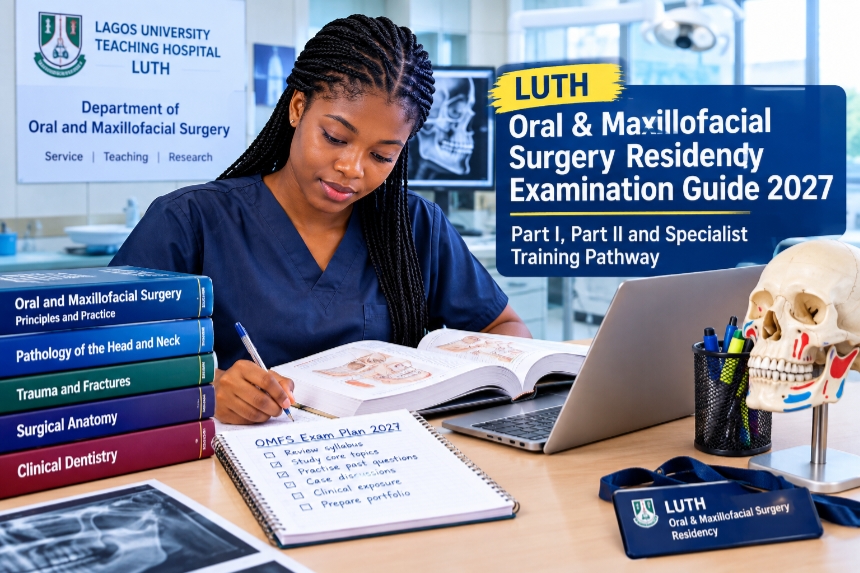
Becoming an Oral and Maxillofacial Surgeon in Nigeria is a long postgraduate journey involving professional registration, structured residency training, clinical experience, examinations and research.
- What Is Oral and Maxillofacial Surgery?
- Who Can Pursue Oral and Maxillofacial Surgery Specialist Training?
- The Three Major NPMCN Examination Stages
- Stage One: The Primary Examination
- Stage Two: Part I Fellowship Examination
- Passing Part I Is Not the End of Specialist Training
- Stage Three: Part II Fellowship Examination
- What Does Part II Preparation Involve?
- Does Passing Part II Make You a Consultant?
- How Long Does Oral and Maxillofacial Surgery Training Take?
- What Does LUTH Offer in Oral and Maxillofacial Surgery?
- Oral and Maxillofacial Surgery Training Through the WACS Route
- What Documents Are Required for NPMCN Examinations?
- Why You Should Organise Your Documents Early
- Research: Start Early, Not During Your Final Year
- Preparing for the Oral and Clinical Examination
- A Practical 6-Stage Study Strategy
- Common Mistakes OMFS Residents Should Avoid
- Mistake 1: Confusing LUTH With the Examination College
- Mistake 2: Using an Outdated Curriculum
- Mistake 3: Ignoring the Logbook
- Mistake 4: Leaving Research Until the Last Minute
- Mistake 5: Preparing Only With Textbooks
- Mistake 6: Ignoring Administrative Requirements
- Mistake 7: Assuming Every Specialty Has the Same Rules
- What Should 2027 Applicants Do Now?
- 2027 Preparation Checklist
- How to Think About the Entire OMFS Journey
- Final Thoughts
For dental graduates considering specialist training at Lagos University Teaching Hospital (LUTH), understanding the examination pathway before applying for residency can help you plan your career more effectively.
One important distinction should be made from the beginning:
LUTH is a major teaching hospital and specialist training institution, but the postgraduate fellowship examinations are conducted within the framework of recognised postgraduate colleges and their applicable curricula.
For candidates following the National Postgraduate Medical College of Nigeria (NPMCN) route, the relevant fellowship examinations include the Primary, Part I and Part II stages. Other candidates may follow a West African College of Surgeons (WACS) pathway, depending on the applicable programme and training arrangements.



LUTH’s Department of Oral and Maxillofacial Surgery provides specialist services and has a stated mission that includes training dental surgeons who can undertake specialist training and research in oral and maxillofacial surgery.
This guide explains the 2027 pathway, examination stages, residency duration, documents, research requirements and practical preparation strategy.



What Is Oral and Maxillofacial Surgery?
Oral and Maxillofacial Surgery (OMFS) is a surgical specialty concerned with diseases, injuries, deformities and other conditions affecting the mouth, jaws, face and related structures.
At LUTH, the Department of Oral and Maxillofacial Surgery lists specialist services including:
- Surgical management of impacted teeth
- Jaw and facial tumour management
- Reconstruction
- Facial fracture treatment
- Cleft lip and palate surgery
- Craniofacial procedures
- Dental implant placement
- Corrective jaw surgery
The department also has responsibilities in teaching, research and specialist professional development.
For a dental graduate interested in this field, specialist residency provides the structured environment needed to develop advanced surgical and clinical competence.
Related Articles


Who Can Pursue Oral and Maxillofacial Surgery Specialist Training?
The pathway discussed in this guide is primarily relevant to qualified dental surgeons who meet the professional registration and postgraduate training requirements of the applicable college and institution.
Before applying for specialist training, confirm:
- Your recognised dental qualification
- Completion of the required internship/pre-registration training
- Professional registration
- Practising licence
- NYSC requirements where applicable
- Primary examination eligibility
- Training institution requirements
- Faculty-specific requirements
Do not assume that admission to a dental degree automatically makes a candidate eligible for specialist residency.
The exact requirements should be checked against the current NPMCN, WACS and training-institution rules applicable to your intended pathway.
The Three Major NPMCN Examination Stages
Candidates researching the NPMCN pathway will generally encounter three major examination stages:
- Primary Examination
- Part I Fellowship Examination
- Part II Fellowship Examination
These should not be described as three separate LUTH examinations.
Rather, they are stages within the postgraduate specialist-training system.
The exact examination format is determined by the relevant faculty and college regulations.
Stage One: The Primary Examination
The Primary Fellowship Examination is the foundational postgraduate examination that precedes specialist residency training within the NPMCN pathway.
For dental candidates, the relevant professional qualification and registration requirements must be satisfied before proceeding.
The Primary stage is designed to assess foundational knowledge in the basic sciences and prepare candidates for postgraduate specialist training.
Why the Primary Examination Matters
Passing the Primary examination is not the same as completing specialist training.
Rather, it is a gateway into the residency pathway.
NPMCN explains that candidates who successfully complete the Primary examination can proceed into accredited postgraduate residency training, subject to the applicable requirements.
For a future Oral and Maxillofacial Surgery resident, this means your preparation should focus on building a strong scientific foundation rather than trying to memorise isolated examination answers.
Stage Two: Part I Fellowship Examination
The Part I Fellowship Examination represents a major transition into advanced specialist training.
NPMCN’s current eligibility guidance states that candidates generally become eligible for Part I after 24 to 36 months of junior residency, depending on the faculty and specialty. The examination assesses cognitive knowledge and basic professional skills relevant to the discipline.
For the Dental Surgery faculty, NPMCN currently lists a minimum of:
- 24 months of Junior Residency
- 36 months of Senior Residency
The actual training structure within Oral and Maxillofacial Surgery should be confirmed against the current faculty curriculum and accredited training programme.
Areas You May Need to Prepare For
Depending on the applicable faculty curriculum and examination format, preparation can involve:
- Clinical knowledge
- Anatomy
- Pathology
- Diagnosis
- Patient assessment
- Surgical principles
- Treatment planning
- Oral examination
- Clinical reasoning
- Basic professional skills
The exact format varies by faculty, and NPMCN directs candidates to the relevant Faculty Handbook for examination details.
Passing Part I Is Not the End of Specialist Training
A common misunderstanding among new residents is assuming that passing Part I means they have completed specialist training.
It does not.
Part I is an intermediate fellowship examination.
After passing Part I, the candidate progresses into Senior Residency, where responsibility, clinical exposure and professional judgement increase.
For Dental Surgery, NPMCN currently specifies a minimum of 36 months of Senior Residency.
This period is also important for research, operative experience, logbook development and preparation for the terminal fellowship examination.
Stage Three: Part II Fellowship Examination
The Part II Fellowship Examination is the terminal fellowship stage of the NPMCN pathway.
Current NPMCN guidance states that candidates become eligible for Part II after:
- Passing Part I
- Completing the required Senior Residency period
- Meeting the applicable examination and documentation requirements
NPMCN currently describes Part II candidates as having completed a further 36 to 48 months of Senior Residency, depending on the applicable faculty and training structure. For Dental Surgery, the published minimum is 36 months.
The examination is intended to assess a higher level of professional judgement, problem-solving and readiness for specialist responsibilities.
What Does Part II Preparation Involve?
By the Part II stage, candidates should be developing advanced competence rather than simply revising undergraduate material.
Requirements can include evidence relating to:
- Clinical training
- Operative procedures
- Logbooks
- Research
- Dissertation
- Case documentation where applicable
- Clinical assessment
- Oral examination
- Professional judgement
- Specialist decision-making
NPMCN’s current Part II requirements include documentation relating to the candidate’s Part I result, research methodology workshop, health resources management workshop, dissertation or applicable casebook, proposal assessment reports and institutional approval.
Does Passing Part II Make You a Consultant?
Passing the terminal fellowship examination is a major professional milestone, but it is important to distinguish professional qualification from employment appointment.
NPMCN states that candidates who pass Part II are eligible to be appointed as consultants.
That does not mean every successful candidate automatically receives a consultant position.
Actual appointment depends on factors such as:
- Available vacancies
- Employer requirements
- Institutional policies
- Professional registration
- Applicable public-service or hospital procedures
Therefore:
Part II Fellowship → eligibility for consultant appointment
does not necessarily mean:
Part II Fellowship → automatic consultant job.
How Long Does Oral and Maxillofacial Surgery Training Take?
The exact duration depends on the postgraduate route, faculty requirements and individual training circumstances.
For the NPMCN Dental Surgery faculty, the current published minimums are:
| Training Stage | Current Minimum |
|---|---|
| Junior Residency | 24 months |
| Senior Residency | 36 months |
| Total listed residency period | 60 months |
The NPMCN examination guidance also states that Part I eligibility generally occurs after the first 24–36 months of Junior Residency, while Part II requires a further 36–48 months of Senior Residency depending on the faculty.
This means candidates should think of OMFS training as a multi-year professional pathway, not a short postgraduate course.
Training may take longer if a candidate needs additional time to satisfy curriculum, research, examination or institutional requirements.
What Does LUTH Offer in Oral and Maxillofacial Surgery?
LUTH is a major tertiary healthcare and teaching institution with a dedicated Department of Oral and Maxillofacial Surgery.
The department’s stated mission includes producing dental surgeons capable of completing specialist training and research in oral and maxillofacial surgery. It also provides specialist services involving facial trauma, tumours, reconstruction, cleft surgery, corrective jaw procedures and other maxillofacial conditions.
LUTH’s current institutional information also identifies Oral and Maxillofacial Surgery among its specialist clinical departments and describes the hospital’s broader mandate in patient care, training and research.
Important distinction
When researching “LUTH OMFS examinations,” separate these two questions:
Question 1: Where can I receive specialist training?
Question 2: Which postgraduate college conducts my fellowship examination?
The answer to the first may involve LUTH or another accredited institution.
The second depends on the postgraduate college and examination route you are following.
Oral and Maxillofacial Surgery Training Through the WACS Route
Nigerian dental specialists may also encounter the West African College of Surgeons (WACS) pathway.
WACS publishes curricula for Dental Surgery fellowship programmes, including Oral and Maxillofacial Surgery.
The published Oral and Maxillofacial Surgery curriculum describes senior-resident competencies in areas such as:
- Severe facial trauma
- Facial cellulitis
- Mandibulectomy
- Maxillectomy
- Tracheostomy
- Orthognathic surgery
- Reconstructive surgery
- Jaw fracture management
- Cleft lip and palate repair
- Temporomandibular joint surgery
- Cyst surgery
- Salivary gland surgery
The exact WACS training and examination requirements should be checked against the current curriculum and College regulations applicable to your cohort.
Do not mix WACS and NPMCN requirements together when preparing an application. Identify your intended postgraduate route first.
What Documents Are Required for NPMCN Examinations?
NPMCN’s current Part I documentation requirements include items such as:
- Recent passport photograph
- Basic medical or dental degree certificate
- NYSC discharge or exemption documentation
- Full professional registration documentation
- Update-course certificate where applicable
- Institutional approval
- Operative procedure records where applicable
- Other faculty-specific documentation
The College’s current Part II requirements additionally include items such as:
- Part I result
- Annual progress reports
- Institutional approval
- Operative procedure records where applicable
- Research Methodology in Medicine Workshop certificate
- Health Resources Management Workshop certificate
- Dissertation documentation
- Proposal assessment reports
- Approved proposal book
- Casebook documents where applicable
- Candidate declaration and indemnity documentation
Requirements can differ by faculty, so candidates should use the current examination portal and Faculty Handbook rather than an old checklist copied from another specialty.
Why You Should Organise Your Documents Early
Postgraduate examination applications can involve many separate documents.
Create a secure digital folder containing:
Academic Documents
- Dental degree certificate
- Relevant academic records
- Professional registration documents
- NYSC documentation
Training Documents
- Certificate of training
- Institutional approval
- Annual progress reports
- Update-course certificates
- Logbook
- Operative procedure records
Examination Documents
- Primary result
- Part I result
- Relevant workshop certificates
- Application confirmations
- Payment receipts
Research Documents
- Research proposal
- Proposal assessment reports
- Approved proposal
- Dissertation documents
- Casebook documents where applicable
Keep both digital and physical backups.
Research: Start Early, Not During Your Final Year
Research becomes particularly important as you progress toward the terminal fellowship examination.
NPMCN’s current Part II documentation includes dissertation-related requirements for all faculties, with casebook requirements applying to relevant faculties. The College also requires proposal assessment documentation and an approved proposal book.
A research project can involve:
- Selecting a suitable topic
- Reviewing existing literature
- Developing the research question
- Preparing the proposal
- Obtaining the necessary approvals
- Collecting data
- Analysing results
- Writing the dissertation
- Completing required assessment or defence processes
Why Early Planning Matters
Research delays can affect an otherwise strong resident.
Discuss your research interests with your supervisors early and understand the requirements of your institution and postgraduate college.
Do not wait until the final months before Part II to discover that important research milestones have not been completed.
Preparing for the Oral and Clinical Examination
Oral and Maxillofacial Surgery is a practical clinical specialty.
Your preparation should therefore focus on clinical reasoning, not only memorisation.
When presented with a case, practise answering the following sequence:
1. What Is the Most Likely Diagnosis?
State the diagnosis clearly.
2. What Evidence Supports It?
Identify the clinical findings and relevant history.
3. What Are the Differential Diagnoses?
Explain the important alternatives and how you would distinguish them.
4. What Investigations Are Required?
Consider the investigations relevant to the case.
5. How Would You Manage the Patient?
Structure your answer logically:
Assessment → Stabilisation where necessary → Investigation → Diagnosis → Treatment planning → Definitive management → Follow-up
6. What Complications Should You Consider?
Think about:
- Immediate complications
- Surgical complications
- Functional consequences
- Long-term outcomes
- Patient-specific risks
This method helps develop the structured clinical thinking required at advanced postgraduate level.
A Practical 6-Stage Study Strategy
Stage 1: Confirm Your Route
Determine whether your intended pathway is through:
- NPMCN
- WACS
- Another recognised postgraduate route
Then identify the relevant faculty curriculum.
Stage 2: Map the Curriculum
Create a study tracker containing:
| Topic | Read | Questions | Clinical Cases | Weak Area |
|---|---|---|---|---|
| Maxillofacial trauma | ✓ | ✓ | ✓ | — |
| Jaw pathology | ✓ | ✓ | — | Imaging |
| Cleft conditions | ✓ | — | ✓ | Management |
| TMJ disorders | ✓ | ✓ | ✓ | Treatment planning |
This makes your preparation measurable.
Stage 3: Combine Reading With Cases
Avoid spending weeks reading without testing yourself.
For each major topic:
Read → Explain → Apply to a case → Discuss management → Review mistakes
Stage 4: Practise Viva Questions
Ask yourself questions aloud.
For example:
“A patient presents with a mandibular fracture. How would you assess and manage the patient?”
Then answer without looking at your notes.
Practise explaining your reasoning clearly and professionally.
Stage 5: Maintain Your Clinical Records
Do not postpone logbook updates.
Record procedures and clinical experiences according to your faculty and institution’s requirements.
A missing or poorly maintained record can become an administrative problem later.
Stage 6: Prepare for the Examination as a Professional
At the senior level, do not think only:
“What is the answer?”
Also ask:
“Why is this the appropriate decision?”
“What are the risks?”
“What alternatives exist?”
“What would change my management?”
That shift from recall to professional judgement is central to advanced specialist training.
Common Mistakes OMFS Residents Should Avoid
Mistake 1: Confusing LUTH With the Examination College
LUTH can be a training institution, while the postgraduate examination may be conducted under NPMCN or WACS.
Mistake 2: Using an Outdated Curriculum
Postgraduate curricula can be revised.
Always use the current faculty and college documents.
Mistake 3: Ignoring the Logbook
Clinical and operative records should be maintained throughout training.
Mistake 4: Leaving Research Until the Last Minute
Part II research requirements take time.
Mistake 5: Preparing Only With Textbooks
Clinical examinations require application and decision-making.
Mistake 6: Ignoring Administrative Requirements
A strong clinical candidate can still encounter problems if certificates, institutional approvals, subscriptions or other required documents are missing.
Mistake 7: Assuming Every Specialty Has the Same Rules
NPMCN explicitly notes that examination formats vary between faculties.
Never copy another specialty’s checklist and assume it applies to Oral and Maxillofacial Surgery.
What Should 2027 Applicants Do Now?
If you are planning to begin or continue Oral and Maxillofacial Surgery specialist training in 2027, start by confirming your professional position.
Check Your:
- Dental qualification
- Professional registration
- Practising licence
- NYSC status
- Primary examination requirements
- Residency eligibility
- Intended training institution
- Applicable postgraduate college
- Faculty curriculum
- Training duration
- Research requirements
- Examination documentation
Then monitor the official announcements from the relevant postgraduate college and training institution.
Do not assume that an examination date, fee or application deadline from 2026 will automatically apply to 2027.
2027 Preparation Checklist
Professional Eligibility
- [ ] Recognised dental qualification
- [ ] Required professional registration
- [ ] Current practising licence
- [ ] NYSC documentation where applicable
- [ ] Primary examination result or exemption where applicable
- [ ] Eligible training institution
Residency
- [ ] Junior Residency requirements understood
- [ ] Senior Residency requirements understood
- [ ] Current logbook maintained
- [ ] Operative procedures recorded
- [ ] Annual progress reports maintained
- [ ] Institutional approvals obtained where required
Part II Preparation
- [ ] Part I successfully completed
- [ ] Research topic selected
- [ ] Research proposal prepared
- [ ] Proposal assessment completed
- [ ] Required workshops completed
- [ ] Dissertation/casebook requirements understood
- [ ] Clinical and operative experience documented
Examination
- [ ] Current Faculty Handbook reviewed
- [ ] Current examination notice checked
- [ ] Application documents scanned
- [ ] Examination fees confirmed from the official source
- [ ] Examination dates confirmed
- [ ] Revision schedule created
- [ ] Clinical/viva practice completed
How to Think About the Entire OMFS Journey
The specialist pathway can be visualised as:
Dental Qualification
↓
Professional Registration / Required Internship and Eligibility
↓
Primary Fellowship Examination
↓
Accredited Specialist Residency
↓
Part I Fellowship Examination
↓
Senior Residency
↓
Research + Clinical/Operative Experience
↓
Part II Fellowship Examination
↓
Specialist Fellowship
↓
Eligibility for Consultant Appointment
The exact route, terminology and requirements depend on the postgraduate college, faculty and current regulations.
Final Thoughts
Oral and Maxillofacial Surgery is a demanding specialist field that requires years of structured clinical training, professional examinations, research and increasing responsibility.
For candidates considering LUTH, the hospital’s Department of Oral and Maxillofacial Surgery provides specialist clinical services and has an explicit teaching, training and research mission.
For the NPMCN pathway, current examination guidance identifies the Primary, Part I and Part II stages, with Dental Surgery currently listed at a minimum of 24 months of Junior Residency and 36 months of Senior Residency.
The most important preparation principle is to start early.
Confirm your route → understand the current curriculum → maintain your clinical records → plan research early → build clinical reasoning → organise your documents → monitor official examination announcements.
Most importantly, do not rely on an old blog post, social-media checklist or another resident’s experience as the final authority. Examination requirements, application dates and documentation can change.
For your 2027 plans, always confirm the latest information directly from the National Postgraduate Medical College of Nigeria, West African College of Surgeons where applicable, LUTH and your relevant training programme.