






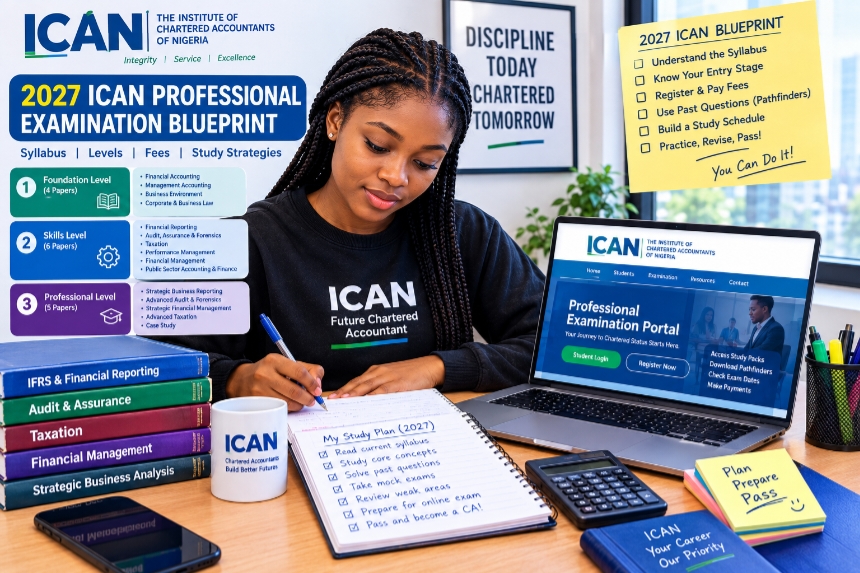
The Institute of Chartered Accountants of Nigeria (ICAN) professional qualification is a structured pathway for graduates and other eligible candidates seeking to qualify as chartered accountants in Nigeria.
- 1. Understanding the ICAN Professional Examination Framework
- 2. Important Changes in the Current ICAN Syllabus
- 3. Who Can Register for the ICAN Professional Examination?
- 4. ICAN Exemptions: How They Work
- 5. ICAN Examination Diets for 2027
- 6. ICAN Examination Fees: What Should You Budget?
- 7. ICAN Study Materials: Start With the Official Resources
- 8. The Pathfinder Strategy: How to Use Past Questions Properly
- 9. The Biggest ICAN Mistake: Studying Only for Recall
- 10. A Four-Stage ICAN Study Blueprint
- 11. How to Prepare for the Professional-Level Papers
- 12. How to Prepare for ICAN Case Study
- 13. Master the ICAN Examination Timing
- 14. A 12-Week ICAN Study Plan
- 15. How Many ICAN Papers Should You Take at Once?
- 16. ICAN Pass Mark and Credit System
- 17. Common ICAN Preparation Mistakes to Avoid
- Mistake 1: Using an Outdated Syllabus
- Mistake 2: Reading Without Practising
- Mistake 3: Ignoring Pathfinders
- Mistake 4: Memorising Without Understanding
- Mistake 5: Ignoring Current Tax and Accounting Developments
- Mistake 6: Poor Time Management
- Mistake 7: Neglecting Presentation
- Mistake 8: Registering Before Confirming Exemptions
- Mistake 9: Treating Every Online “ICAN Secret” as Official
- 18. ICAN vs ATSWA: What Is the Difference?
- 19. Beyond the Examination: Becoming an ICAN Chartered Accountant
- 20. Your 2027 ICAN Preparation Checklist
- 21. The 2027 ICAN Success Formula
- Final Thoughts
But preparing for ICAN is not simply about memorising accounting rules. The current syllabus increasingly emphasizes application, analysis, professional judgement, ethics, technology, taxation, financial reporting, audit and business decision-making.
For candidates targeting the 2027 ICAN examination diets, understanding the current structure is essential. ICAN’s professional examination is divided into Foundation, Skills and Professional levels, with 15 subjects in total. The current syllabus took effect from the November 2025 diet and may continue to be updated, so candidates should always use the latest syllabus and examination notice issued by ICAN for their particular diet.
This guide explains the current framework, subjects, exemptions, fees, study materials, Pathfinder strategy, examination rules and a practical study plan for 2027.



1. Understanding the ICAN Professional Examination Framework
The current ICAN professional examination consists of three levels and 15 subjects:
| Level | Number of Papers | Main Focus |
|---|---|---|
| Foundation | 4 | Knowledge and understanding |
| Skills | 6 | Analysis, interpretation and application |
| Professional | 5 | Professional judgement, evaluation and integration |
ICAN describes the Foundation level as the building block for higher levels, the Skills level as an application-focused stage, and the Professional level as the stage where candidates handle more complex business situations and professional judgements.



Foundation Level — 4 Papers
The current Foundation subjects are:
- A1 — Business Environment (BE)
- A2 — Financial Accounting (FA)
- A3 — Management Accounting (MA)
- A4 — Corporate and Business Law (CBL)
The Foundation level covers areas such as business processes, economics, management, accounting frameworks, cost accounting, budgeting, decision-making, company law, commercial transactions and employment law.
Skills Level — 6 Papers
The current Skills subjects are:
- B1 — Financial Reporting (FR)
- B2 — Audit, Assurance and Forensics (AAF)
- B3 — Taxation (TAX)
- B4 — Performance Management (PM)
- B5 — Financial Management (FM)
- B6 — Public Sector Accounting and Finance (PSAF)
The Skills level moves beyond basic knowledge and expects candidates to apply accounting and business concepts to practical situations.
Related Articles



Professional Level — 5 Papers
The Professional level consists of:
- C1 — Strategic Business Reporting (SBR)
- C2 — Advanced Audit, Assurance and Forensics (AAAF)
- C3 — Strategic Financial Management (SFM)
- C4 — Advanced Taxation (ATAX)
- C5 — Case Study (CS)
The Professional level requires candidates to integrate knowledge from earlier stages and make professional judgements in complex business situations. The Case Study is particularly focused on analysing an unstructured business scenario and communicating recommendations in a professional report.
2. Important Changes in the Current ICAN Syllabus
Candidates using old ICAN materials should be careful because the syllabus was revised.
The current structure replaced several names and changed the Skills-level composition. For example:
- Business, Management and Finance became Business Environment.
- Management Information became Management Accounting.
- Business Law became Corporate and Business Law.
- Audit and Assurance became Audit, Assurance and Forensics.
- Financial Management was added to the Skills level.
- Corporate Reporting became Strategic Business Reporting.
- Advanced Audit and Assurance became Advanced Audit, Assurance and Forensics.
The current syllabus also incorporates developments in areas such as IFRS 17, IFRS 18, sustainability reporting and Nigerian tax reforms.
What this means for 2027 candidates
Do not build your entire preparation around an old textbook, tutorial video or 2021 syllabus.
Instead:
- Download the latest ICAN syllabus.
- Check the examination notice for your diet.
- Use the current ICAN study materials.
- Confirm whether any syllabus updates have been issued before the 2027 examination.
- Use Pathfinders from recent diets to understand how questions are being examined.
ICAN states that its curriculum is regularly updated to reflect developments in the accountancy profession.
3. Who Can Register for the ICAN Professional Examination?
ICAN’s current professional-student information states that applicants generally need a qualification not below a university degree or equivalent, with recognised university degrees, qualifying HNDs and other Council-approved qualifications forming part of the entry routes.
However, your academic qualification can affect the level and subjects you need to take because ICAN provides exemptions.
That means two candidates with different academic backgrounds may not start the examination at exactly the same point.
Examples of qualifications that may attract exemptions
Depending on the qualification and ICAN’s current exemption rules, exemptions may be available for candidates holding qualifications such as:
- B.Sc./HND Accounting from recognised institutions
- Certain accounting master’s degrees
- Accounting qualifications from ICAN-accredited institutions
- ATSWA
- Certain professional qualifications
- Some degrees in areas such as economics, business administration, banking and finance, insurance and related disciplines
The exact exemption depends on the qualification, institution, professional status and applicable ICAN rules.
Do not assume that having an accounting degree automatically means you can skip every Foundation or Skills paper. Check your individual exemption status before registering for examinations.
4. ICAN Exemptions: How They Work
ICAN publishes exemption categories and applicable rates.
For example, its current exemption information lists different treatment for:
- Accounting degrees from ICAN-accredited institutions
- Accounting degrees from recognised but non-accredited institutions
- Certain master’s degrees
- ATSWA
- Other recognised professional qualifications
Some candidates can receive exemptions from substantial portions of Foundation and Skills, while others may receive only selected subject exemptions.
Exemption planning checklist
Before paying for examination papers:
- Confirm your qualification.
- Confirm whether your institution is recognised or accredited where relevant.
- Check the exact subjects for which you qualify for exemption.
- Apply for the exemption where required.
- Confirm that the exemption has been successfully processed.
- Only then register for the examination papers you still need.
This matters because ICAN’s examination notices warn candidates to confirm exemption status before paying examination fees.
5. ICAN Examination Diets for 2027
ICAN’s current syllabus states that the Professional Examination is held twice a year — May and November.
Therefore, candidates planning for 2027 should expect the examination cycle to revolve around:
- May 2027 diet
- November 2027 diet
However, exact 2027 registration windows, examination dates, fees and timetable details should be taken from the official ICAN notice when published.
Do not rely on a blog’s copied deadline as the final authority.
A practical 2027 planning approach
For the May diet:
- Begin preparation several months ahead.
- Complete syllabus mapping early.
- Start intensive past-question practice before registration closes.
- Leave sufficient time for revision and examination simulation.
For the November diet:
- Use the months after the May diet to assess weaknesses.
- Begin structured preparation early rather than waiting for the timetable.
- Review the latest syllabus and any changes before the final revision period.
6. ICAN Examination Fees: What Should You Budget?
One of the most important points about a 2027 ICAN fee guide is that exact 2027 fees should not be presented as fixed until ICAN publishes the applicable examination notice.
The latest published 2026 Nigerian examination schedule provides a useful planning benchmark.
2026 Professional Examination Fee Benchmark
| Level | 1 Paper | 2 Papers | 3 Papers | 4 Papers | 5 Papers | 6 Papers |
|---|---|---|---|---|---|---|
| Foundation | ₦26,570 | ₦33,920 | ₦41,270 | ₦48,610 | — | — |
| Skills | ₦37,490 | ₦49,250 | ₦61,110 | ₦72,870 | ₦84,740 | ₦95,500 |
| Professional | ₦40,740 | ₦53,970 | ₦67,310 | ₦80,540 | ₦93,870 | — |
These were the fees published for the May 2026 diet and are not a guarantee of 2027 prices. Additional charges or changes may apply according to the applicable diet notice.
ICAN’s FAQ also instructs students to check their examination and financial status before payment and notes that examination fees are non-refundable.
Other costs to consider
Your ICAN budget may also include:
- Student registration costs
- Annual subscription
- Exemption fees, where applicable
- Study materials outside ICAN’s free resources
- Tutorial or revision classes
- Transportation
- Internet/data costs
- Examination-related administrative charges where applicable
Avoid budgeting only for the examination fee.
7. ICAN Study Materials: Start With the Official Resources
ICAN provides registered students with access to official study materials.
These include:
- Study Packs
- Pathfinders
- Mock Questions and Answers
- Examination information and guidelines
ICAN’s student FAQ states that current soft-copy study materials are available online to students who have registered for the examination.
The Institute’s professional learning-materials section also provides Pathfinders for previous examination diets, including Foundation, Skills and Professional materials.
Your core preparation library should therefore contain:
- Latest ICAN syllabus
- Current ICAN study pack
- Recent Pathfinders
- Mock questions
- Your own topic summaries
- A calculation/formula notebook where relevant
- A mistake notebook
8. The Pathfinder Strategy: How to Use Past Questions Properly
Past questions are valuable, but simply reading their answers is not enough.
A Pathfinder can help you understand not only what was asked but also the examiner’s expectations and common weaknesses in candidates’ answers.
The 4-Step Pathfinder Method
Step 1: Attempt the Question Before Reading the Solution
Take a question from a recent diet and solve it without looking at the answer.
For computational questions, write out the complete workings.
For theory questions, structure your answer as though you were in the examination hall.
Step 2: Compare Your Answer With the Expected Approach
Look for:
- Missing calculations
- Incorrect assumptions
- Poor explanations
- Failure to answer the actual requirement
- Missing professional recommendations
- Poor presentation
- Time-management problems
Step 3: Study the Examiner’s Comments
Do not ignore comments about common candidate errors.
Ask:
“What did the examiner expect candidates to demonstrate here?”
That question is often more useful than simply asking whether your final answer is correct.
Step 4: Repeat the Question Under Time Pressure
After studying the solution, return to a similar question later and attempt it without assistance.
This converts passive reading into actual examination practice.
9. The Biggest ICAN Mistake: Studying Only for Recall
ICAN’s current syllabus differentiates the competency expectations at each level:
- Foundation: knowledge and understanding
- Skills: analysis, interpretation and application
- Professional: judgement and evaluation
This means your study method should change as you progress.
Foundation
Ask:
What does this concept mean?
Skills
Ask:
How do I apply this concept to a business situation?
Professional
Ask:
What does the evidence show, what are the alternatives, what are the risks and what should management do?
This progression is especially important for Professional-level papers and Case Study.
10. A Four-Stage ICAN Study Blueprint
Stage 1: Map the Syllabus
Start by obtaining the current syllabus for your diet.
Create a spreadsheet or notebook with columns such as:
| Topic | Syllabus Requirement | Study Status | Questions Attempted | Weakness |
|---|---|---|---|---|
| IFRS topic | Explain/apply | Started | 12 | Consolidation |
| Tax topic | Compute/discuss | Completed | 20 | Tax adjustments |
| Audit topic | Evaluate | Started | 15 | Evidence |
| Finance topic | Calculate/evaluate | Completed | 18 | Time value |
This prevents the common mistake of studying only the topics you enjoy.
Stage 2: Build Conceptual Mastery
Do not memorise formulas without understanding what they represent.
For accounting and finance subjects, ask:
- What is the underlying principle?
- Why is this treatment required?
- What information is relevant?
- What assumptions are being made?
- What changes if the facts change?
For Financial Reporting, keep up with the standards specifically included in your current ICAN syllabus.
The current syllabus incorporates recent developments including IFRS 17 and IFRS 18.
Stage 3: Move Heavily Into Question Practice
Once you understand a topic, start solving questions.
A practical weekly structure could be:
- 30%: reading and concept review
- 50%: question practice
- 20%: correction, revision and error analysis
These percentages are a study framework, not an ICAN requirement. Adjust them according to your strengths and the level you are taking.
Keep a mistake notebook
Every time you make an important mistake, record:
Question → Error → Correct method → Why I made the mistake → How I will prevent it
Review this notebook every week.
11. How to Prepare for the Professional-Level Papers
The five Professional papers require different preparation approaches.
C1 — Strategic Business Reporting
Focus on:
- Financial reporting principles
- Complex reporting scenarios
- Group financial statements
- Analysis and interpretation
- Relevant IFRS requirements
- Professional judgement
- Clear reporting and explanation
C2 — Advanced Audit, Assurance and Forensics
Develop your ability to:
- Identify risks
- Evaluate evidence
- Design appropriate responses
- Understand assurance issues
- Analyse fraud and forensic scenarios
- Communicate findings professionally
C3 — Strategic Financial Management
Give serious attention to:
- Investment decisions
- Financing decisions
- Valuation
- Risk management
- Treasury issues
- Mergers and acquisitions
- Strategic financial analysis
C4 — Advanced Taxation
Tax candidates should avoid studying only from old notes because Nigerian tax legislation and administrative requirements can change.
The current syllabus incorporates the Nigeria Tax Reform Acts, 2025, among other recent developments.
Always study the tax legislation and provisions specified in the current ICAN syllabus for your examination diet.
C5 — Case Study
Case Study requires a different mindset.
You are not simply answering isolated accounting questions.
You are analysing a business scenario and producing a professional response.
The current ICAN syllabus describes the Case Study as an integrated assessment requiring candidates to analyse an unstructured scenario and produce a professional report.
12. How to Prepare for ICAN Case Study
A useful Case Study framework is:
1. Understand the Business
Identify:
- What the organisation does
- Its objectives
- Its stakeholders
- Its financial position
- Its operating environment
2. Identify the Problems
Separate symptoms from underlying problems.
For example:
Symptom: declining profitability.
Possible underlying issues: rising costs, poor pricing, inefficient operations, financing problems or declining demand.
3. Analyse the Evidence
Use the information supplied in the scenario.
Avoid introducing unsupported assumptions.
4. Evaluate Alternatives
Consider:
- Financial implications
- Operational implications
- Risks
- Stakeholder effects
- Legal/regulatory issues
- Ethical considerations
5. Make Clear Recommendations
Your recommendation should follow from the evidence.
6. Present Professionally
Practise producing:
- Executive summaries
- Headings
- Structured analysis
- Conclusions
- Recommendations
- Appendices where appropriate
The current syllabus specifically incorporates professional judgement, ethics, communication and business analysis into the examination framework.
13. Master the ICAN Examination Timing
Under the current syllabus, most ICAN examination papers are three hours with an additional 15 minutes of reading time.
The Case Study is four hours, including reading time.
That means your preparation should include actual timed practice.
Do not wait until examination week to practise timing.
Instead, gradually move from:
Untimed practice → timed sections → half-paper simulations → full examination simulations
During a mock examination:
- Do not pause the clock.
- Do not check your phone.
- Do not open your textbook.
- Do not search online.
- Use only the permitted examination resources.
- Review your performance after the session.
14. A 12-Week ICAN Study Plan
Weeks 1–3: Syllabus and Concept Building
- Download the latest syllabus.
- Divide subjects into topics.
- Identify difficult areas.
- Read the relevant study materials.
- Create concise revision notes.
Weeks 4–6: Guided Question Practice
- Begin topic-by-topic questions.
- Solve calculations manually.
- Write theory answers.
- Compare responses with Pathfinders.
- Record recurring mistakes.
Weeks 7–9: Mixed Practice
Stop studying topics in isolation.
Start combining questions from different areas.
For example:
- Financial Reporting + Taxation
- Audit + Financial Reporting
- Finance + strategic decision-making
- Tax + business restructuring
This helps develop the integrated thinking expected at higher levels.
Weeks 10–11: Timed Mock Examinations
Complete full papers under examination conditions.
After each mock:
- Calculate your score.
- Identify weak areas.
- Review the relevant syllabus section.
- Reattempt failed questions.
- Repeat the process.
Week 12: Final Revision
Focus on:
- Formulae
- Key standards
- Tax rules applicable to your syllabus
- Common question types
- Professional-report structure
- Common mistakes
- Weak topics
Avoid trying to learn an enormous amount of new material at the last minute.
15. How Many ICAN Papers Should You Take at Once?
There is no universal number that suits every candidate.
Your decision should consider:
- Number of available study hours
- Work schedule
- Family responsibilities
- Previous examination performance
- Difficulty of the subjects
- Your academic background
- Whether you are repeating papers
- Your financial situation
ICAN’s current rules allow candidates to register for any number of papers at a level, with candidates credited for papers they pass. Candidates are generally expected to complete one level before proceeding to a higher level.
For many working candidates, taking fewer papers can make it easier to allocate sufficient preparation time to each subject. The appropriate workload is ultimately a personal planning decision rather than a universal rule.
16. ICAN Pass Mark and Credit System
The current ICAN syllabus specifies a 50% pass mark for each examination subject.
Candidates receive credit for papers they pass.
However, the Institute’s current rules also state that candidates generally cannot proceed to the next level until all subjects in the preceding level have been successfully completed.
Important note about Professional-Level credit validity
ICAN’s published materials should be checked carefully when planning a long-term Professional-Level journey because recent official documents have not been completely consistent on the applicable time limit.
The updated syllabus contains a ten-diet provision, while the May 2026 examination notice stated that the ten-year rule had been waived and referred to a five-year rule for affected candidates.
For a 2027 candidate, the safest approach is to check the specific 2027 examination notice and your student record before relying on any credit-expiry rule.
17. Common ICAN Preparation Mistakes to Avoid
Mistake 1: Using an Outdated Syllabus
The syllabus has changed.
Always confirm that your study material corresponds with your examination diet.
Mistake 2: Reading Without Practising
Knowing a topic is different from being able to answer an examination question.
Mistake 3: Ignoring Pathfinders
Pathfinders can reveal how questions are structured and where candidates commonly lose marks.
Mistake 4: Memorising Without Understanding
This becomes particularly dangerous in Skills and Professional-level papers.
Mistake 5: Ignoring Current Tax and Accounting Developments
Tax and financial reporting content can change.
Use the current syllabus as your control document.
Mistake 6: Poor Time Management
A candidate may know the material but still fail to demonstrate enough of it within the examination period.
Mistake 7: Neglecting Presentation
Professional examinations require more than calculations. Clear workings, logical explanations and well-structured answers matter.
Mistake 8: Registering Before Confirming Exemptions
Confirm your exemption status before paying for papers.
Mistake 9: Treating Every Online “ICAN Secret” as Official
Social media advice can become outdated quickly.
Use ICAN’s official website, syllabus, examination notices and student portal for final decisions.
18. ICAN vs ATSWA: What Is the Difference?
The two programmes serve different stages of accountancy development.
ATSWA
The Accounting Technicians Scheme West Africa (ATSWA) is designed around accounting technician-level training and competence.
ICAN Professional Examination
The ICAN Professional Examination is the route for candidates pursuing the Institute’s Chartered Accountant qualification.
ICAN states that holders of recognised bachelor’s degrees, HNDs and certain approved qualifications can be eligible for the Professional Examination, while ATSWA operates as a separate technician pathway.
If you already hold a university degree or HND, check the Professional route and applicable exemptions before assuming that you must first complete ATSWA.
19. Beyond the Examination: Becoming an ICAN Chartered Accountant
Passing the examination is an important part of the qualification process, but it is not the only component.
ICAN’s current syllabus identifies four components of the ICAN-ACA professional accountancy qualification, including:
- Professional examinations
- Practical work experience
- Professional development
- Ethics and professionalism
The current syllabus states that students need at least 36 months of practical work experience, with specific rules governing prior and post-registration experience.
ICAN also states that candidates must satisfy the required components before being admitted into membership.
Therefore, do not think of the journey as simply:
Register → Pass exams → Automatically become ACA
Your practical experience, professional requirements and membership/induction procedures also matter.
20. Your 2027 ICAN Preparation Checklist
Before your examination, make sure you have:
Registration
- [ ] Confirmed your eligibility
- [ ] Confirmed your exemption status
- [ ] Registered as an ICAN professional student
- [ ] Cleared applicable financial obligations
- [ ] Registered for the correct examination papers
- [ ] Confirmed your examination centre
- [ ] Downloaded your examination docket when available
Study
- [ ] Downloaded the latest syllabus
- [ ] Obtained the current study packs
- [ ] Collected recent Pathfinders
- [ ] Practised mock questions
- [ ] Created a mistake notebook
- [ ] Completed timed examinations
- [ ] Reviewed weak areas
- [ ] Studied current developments specified in the syllabus
Examination Readiness
- [ ] Confirmed examination date and time
- [ ] Confirmed examination venue
- [ ] Read current examination rules
- [ ] Planned transportation
- [ ] Prepared permitted examination materials
- [ ] Practised time management
- [ ] Avoided last-minute cramming
21. The 2027 ICAN Success Formula
There is no legitimate shortcut that guarantees an ICAN pass.
A more reliable preparation model is:
Current Syllabus + Official Study Materials + Pathfinder Analysis + Consistent Practice + Timed Mocks + Error Correction + Professional Answering Skills
Do not measure your preparation by how many hours you sit with a textbook.
Measure it by what you can recall, calculate, analyse, explain, evaluate and communicate under examination conditions.
The most important principle is simple:
Study the syllabus, practise the questions, learn from your mistakes and keep your preparation aligned with the latest ICAN instructions.
Final Thoughts
The 2027 ICAN Professional Examination should be approached as a structured professional-development journey rather than a last-minute examination project.
The current framework contains 15 subjects across Foundation, Skills and Professional levels, with increasing emphasis on application, analysis, professional judgement, ethics and integrated business problem-solving.
For candidates preparing now, the best starting point is to determine your correct entry level and exemptions, obtain the latest syllabus, build a realistic study timetable and begin working through recent Pathfinders.
Most importantly, remember that 2027 fees, deadlines, timetables and any syllabus updates should be confirmed from the official ICAN notice when released. The 2026 figures in this guide are planning benchmarks, not promises of the final 2027 charges.
With disciplined preparation, realistic scheduling and extensive question practice, you can approach your ICAN examination with a much clearer understanding of what the Institute expects.
Related Reading on ScholarshipDreamsHaven
- Step-by-Step Guide to ICAN Online Registration
- How to Prepare for Professional Certification Exams in Nigeria
- Accounting Scholarships Abroad for Nigerian Students
- Best Professional Certifications for Accounting and Finance Graduates
- How to Build a Strong Accounting Career After University